
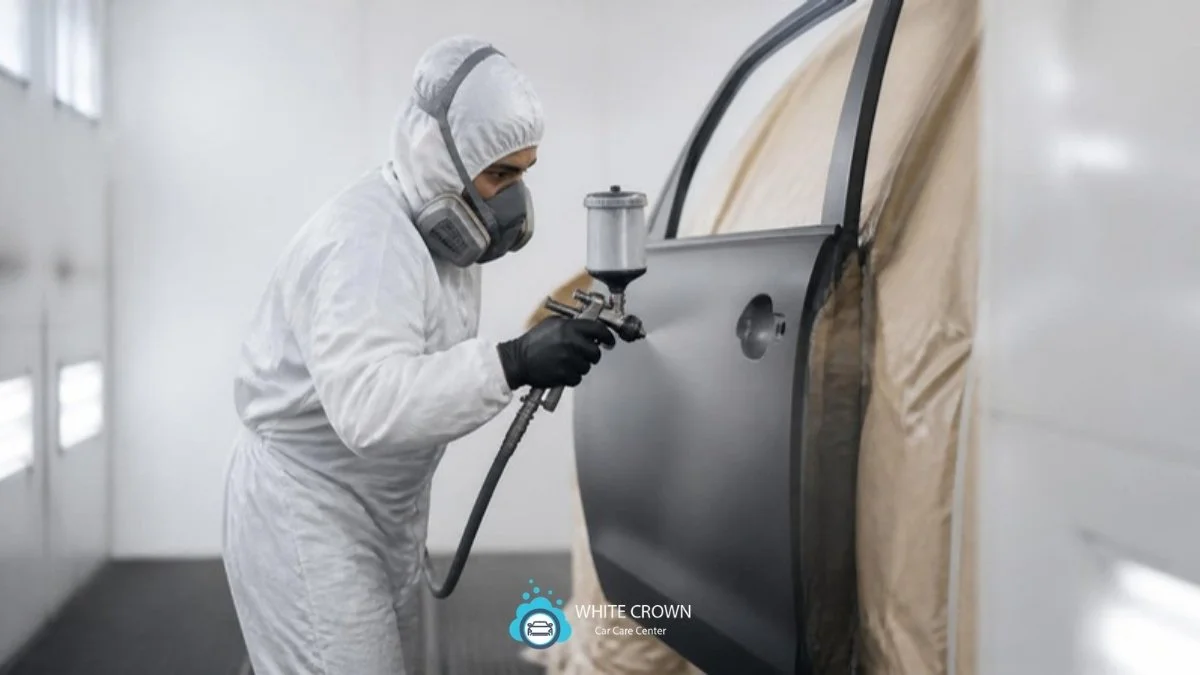
A long scratch down a door from a tight parking space. A small crack in the paint at the corner of the bumper. A bonnet that has started to fade and peel after a few Qatar summers. In each case the same question comes up: does the whole panel need repainting, or will a small spot repair do? The answer decides the cost and the time in the workshop, and how much of your car’s factory paint you keep.
Here is how a full respray, a panel repaint and a smart repair differ, and when you don’t need paint at all.
First: do you actually need paint?
A lot of damage that looks like it needs a respray doesn’t:
- Light scratches and swirl marks: if they sit in the clear coat, an exterior polish removes them without any paint. A quick test: run a fingernail across the scratch. If it doesn’t catch, polishing will usually take it out.
- Dents with unbroken paint: door dings and small dents can often be pushed out with paintless dent repair (PDR), so the factory paint stays untouched.
- Light fading: paint that has gone dull from surface oxidation can sometimes be brought back with a polish, as long as it hasn’t started to peel.
If the scratch has gone through to the colour or bare metal, the clear coat is peeling, or the paint cracked when the panel was hit, that’s when paint comes in. Our article on paint correction vs polishing explains where polishing stops.
Three kinds of paintwork
Smart repair (Smart Paint)
A spot repair of the damaged area only: a medium scratch, a scuffed bumper corner, a small patch of peeling. The small area is prepared, the matched colour is sprayed and then blended into the surrounding paint. It’s quicker and cheaper, and it keeps as much original paint as possible. The limit is size: it suits small defects, not large areas or colour that has faded across a whole panel.
Panel repaint
The whole damaged panel is repainted: a door, a wing, a bonnet. It’s the right call when damage covers a large part of the panel, or when fading and peeling cover a whole surface, which in Qatar is most often the bonnet and roof. The challenge is matching the colour to the panels next to it, especially with metallic and pearl paints, so the new colour is sometimes blended into the neighbouring panel so the difference doesn’t show in sunlight.
Full respray
The whole car is repainted after the surface is prepared, the old paint sanded and defects repaired. It makes sense when the paint is tired on several panels, or when you want a complete colour change. It takes the longest, usually 3 to 5 days depending on the car and the amount of work.
At a glance
| Smart repair | Panel repaint | Full respray | |
|---|---|---|---|
| Best for | Small scratch or scuff | Damage or fading across one panel | Tired paint on several panels, or a colour change |
| Factory paint | Mostly kept | Replaced on repainted panels only | Replaced everywhere |
| Time | Shortest | Medium | Longest (usually 3–5 days) |
| Main challenge | Blending the edges | Matching neighbouring panels | Preparation and finish quality |
What about rubber paint?
Rubber (peelable) paint isn’t a paint repair. It’s a removable layer that changes the look of the body, wheels or trim, and it can be peeled off later without harming the colour underneath. It’s a good fit if you want a temporary change, like turning chrome trim black, but it doesn’t fix scratches or peeling underneath.
What makes a good paint job
- Preparation: most paint problems, such as bubbles, early peeling and visible edges, come from rushing the prep before spraying.
- An enclosed paint booth: dust is the biggest enemy of fresh paint, and Qatar has plenty of it. Spraying in a closed booth keeps sand off the wet finish.
- Colour matching: by the car’s paint code, then tested on the car itself, because original paint shifts slightly with age.
- A final polish: so the repainted area has the same gloss as the rest of the car.
After painting
- Don’t wash the car for the first 7 days, so the paint can cure.
- Wash by hand with a pH-neutral shampoo and avoid brush car washes.
- Remove bird droppings quickly, before they dry on the new paint.
- Ask how long to wait before polishing, applying ceramic coating or fitting paint protection film on freshly painted panels.
Car painting at White Crown
Our car painting service covers full resprays, panel repaints, smart repairs and rubber paint, plus Black Edition and Chrome Delete conversions, all done in enclosed paint booths. We always start by inspecting the car, and if the problem can be solved with a polish or paintless dent repair, we’ll tell you before any paint goes on. Send us clear daylight photos of the panel and we’ll suggest the right fix.
Send photos of the panel on WhatsApp
FAQ
What’s the difference between a smart repair and a full respray?
A smart repair fixes a small damaged area and keeps the rest of the original paint, while a full respray renews the paint on the whole car.
Can a scratch be fixed without paint?
Yes, if it’s in the clear coat, polishing removes it. If it has reached the colour or metal, it needs a spot repair.
How long does a full car respray take?
Usually 3 to 5 days, depending on the car’s condition and the amount of work.
When can I wash my car after painting?
Wait at least 7 days, then wash gently by hand.